
Neo home robot
Physical AI, humanoid robotics: What are the keys to success?
The AI models you use will soon expand into the physical world, thanks to the down-scaling of AI computing processors, smooth real-time communication with humans in natural language, and a multimodal perception of the environment. This includes text and 3D images, as well as sounds, vibrations, colours, smells, force feedback when grasping, together with everything related to human signals such as speech, movements, and emotions expressed on faces and in voices.
AI will disrupt robotics. What is now referred to as physical AI spans perception, autonomous real-time decision-making that factors in the environment, as well as action. It will drive the equipment of tomorrow, whether it takes the form of a machine or a humanoid robot.
The dimension that physical AI designers need to add is the relationship with humans. Because beyond simply giving orders, humans are an integral part of the machine-human system. The extent to which smartphones have transformed our lives prefigures more changes to come with physical AI.
As practitioners of industrial design and innovation marketing, we offer an approach to make physical AI relevant, acceptable and desirable, working from the design phase onwards on two new areas:
- Editorializing AI training data.
- Giving robots clear personality traits to facilitate their adoption, because we understand intuitively how to interact with them.
To set your physical AI project on a success path, read on!
1-The current autonomy scale: A scale whose end point is to supersede humans
Until now, the system autonomy has been measured using a standardised scale that assesses a system’s ability to act without human intervention. The table below compares the levels of autonomy of three systems: cars, trains, and an AI-based control and command system.
| Level | Automotive | Train | Control & Command |
|---|---|---|---|
| 0 | The driver remains in complete control of the vehicle. Everything is manual | No automation: Humans do everything | |
| 1 | The vehicle can control speed or steering in certain conditions, under the driver’s complete control | Analytical support: Humans make decisions with analytical support | |
| 2 | The vehicle can control speed and steering in certain circumstances | GoA1 manually controlled train equipped with a system that prevents speeding | Strategic support: Humans make most decisions, supported by AI |
| 3 | The vehicle performs most tasks, but only under certain conditions. As soon as the system is no longer able to drive, the driver must take back control | GoA2 provides automatic control of the train’s acceleration and braking. The driver in the cab remains responsible for safety and obstacle detection. He manages the doors, departure and contingencies | Structured human oversight: Humans are responsible for AI decisions |
| 4 | The vehicle decides in most situations. The driver intervenes in certain cases | GoA3 fully automatic train that controls traction and braking, as well as obstacle detection. It monitors the condition of the train and detects problems in the environment. A person in the driver’s cab at all times is not necessary | AI-driven analysis: Humans intervene only in exceptional cases |
| 5 | Fully autonomous car, no need for pedals or steering wheel | GoA4 the train is capable of managing everything and has no staff on board | Autonomous collaboration: Humans focus on strategic tasks |
2-A techno-centric metric
These scales are must-haves to mark technological progress and reduce the system’s decision-making error rate. Yet as soon as the system becomes more efficient than humans, they are no longer sufficient.
- Humans are stripped of their prerogatives of control and command: this is an anxiety-provoking vision that arouses rejection. Autonomous vehicles are a case in point: over the past 10 years, they have generated a lot of negative perceptions, even though they make far fewer errors per kilometre travelled than humans. The idea of autonomous vehicles goes against our belief that we are good drivers. Globally, between 80% and 93% of motorists rate themselves positively, regardless of the reality of road risk or the level of local offences. Even older people, whose driving abilities are deteriorating, are put off by the idea of fully autonomous vehicles, even though they appreciate driving aids that compensate for their deficiencies.
- Once the target technical performance levels have been achieved, the challenge for physical AI is clear: to create machines that preserve or enhance human capabilities. By claiming to free humans from the ‘arduous’ task of driving, it calls into question our intimate relationship with driving: what about the impromptu detour depending on mood and circumstances? Despite its image being tarnished by the ecological emergency, the car remains the symbol of human autonomy. To be adopted, the autonomous car will not only have to comply with traffic regulations and avoid accidents, it will have to assume its role as a social object and behave in accordance with the humans around it.
- An autonomous car is designed according to its social environment:
- It will have an impact on motorists in traffic. Some, for example, will confer on it the status of a vehicle at the top of the social ladder, deserving of deference and priority.
- It will have an impact on residents in the neighbourhoods it travels through. It is easy to imagine teenagers testing its limits by deliberately throwing a ball in front of it. However, others, less benevolent, may see it as an ideal target for expressing their frustration. In this case, the autonomous car shouldn’t be left unattended in the street .
- Its decisions in a pre-crash situation have societal consequences: if the car cannot stop, is it better to run over the children or the adult accompanying them? The answer to this ethical dilemma will vary from country to country.
3-Develop interactions with humans on a variety of fronts
Analysing the behaviour of AI users reveals a strong human-machine interaction. A study published in December 2025 on the uses of 37.5 million Microsoft Copilots shows how much users have integrated AI into their personal and professional activities, making Copilot a true life companion for their work, existential questions and even relationship difficulties.
Psychiatrist Raphaël Gaillard has identified three root causes for this relationship: “In prehistoric times, in order to survive, […] humans had to understand the actions and reactions of wild animals. When faced with something endowed with a form of intelligence, we are confronted with an asymmetry of information: it is impossible for us to know the extent of this intelligence, of which we perceive only a few visible effects, […] we are cautious in considering that this intelligence could surprise us, and therefore assume it to be great. Then comes a third stage, in which this intelligence proves capable of saying something relevant. At the very least, its behaviour, similar to our own, reminds us of what we know about ourselves, which is not much, creating a bond of brotherhood, or at least a sense of shared functioning. This similarity lays the foundations for a relationship whose intensity should not be underestimated. What’s more, if this intelligence proves capable of describing how we function […] we feel something even deeper towards it. A mixture of fear, but also affection.”
The design of AI-enabled robots must factor in these anthropological risks and opportunities. It must natively embrace brand new dimensions such as:
- The role of sensorial signals and emotions in human decision-making.
- The rituals of power transfer between humans and machines: How does the machine bring the user back into the loop when it is time for them to take back control? How does it ensure that the user is not asleep?
- The need for learning loops to help the user progress.
This list of opportunities is far from exhaustive! Hospital operating theatres, schools, special education centres, industrial workshops, labs, sports halls, vineyards, combat zones, retail outlets: the variety of use cases and users will determine how performance is measured, whether that of the user, the machine, or the human-machine tandem.
The table below imagines what a performance scale could look like, based on the system’s ability to teach humans in the context of word processing or driving. This scale has two economic objectives:
- to reduce the initial training time for users of the machine, by focusing on the fundamentals for quick mastery, then gradually introducing more advanced concepts.
- to make some skilled jobs that struggle to recruit, more attractive.
| Learning scale | Word processing | Driving school car | ||
|---|---|---|---|---|
| 0 | Control & command | The user must first learn how to operate the machine | Manual typewriter | No driving assistance |
| 1 | Adaptation | The machine is configured by the user for optimal adaptation to their needs and their context of use | Word processing settings (language, font size and typeface) | The car alerts the driver to dangerous situations or behaviour |
| 2 | Assistance | The machine corrects certain user’s errors or effectively extends their intentions | Automatic spelling and grammar correction | The car prevents errors: stability correction, emer-gency braking etc. |
| 3 | Companion | The machine helps users make decisions based on a body of reference knowledge and historical data: the more users work with the machine, the more they use improves. The machine answers user’s questions | Interface adapted to the user’s level. Grammar and style improvement, adaptation of language to context and target readers | The car suggests improvements to the driver. The instructor sets priorities based on the profile of their students. |
| 4 | Training | The machine assesses what has been produced, any discrepancies and deviations. It suggests areas for improvement and proposes advanced features | Evaluation of text quality by a third party, or readers. Feedback, real-time and final quality control | The car administers the driving test. The instructor grants the driving licence. |
4-For relevant physical AI, editorialise the training data
Another step is required in the design phase: carefully selecting and indexing the data sets to train the physical AI.
Take, for example, the design of a tourniquet for first aid to be given to a soldier wounded on the front line. The designer wants to use generative AI to develop the best product. The first challenge is that the use of open-source general-purpose AI is not possible in the military sector, as field data is classified and prompts must remain confidential. In a specialised proprietary AI, training data will have to be selected, formatted and duly classified: data origin, context, quality, potential bias, version traceability.
In the healthcare context, the editorialization of training data will be required to comply with European regulations on AI safety. AI models that are trained on trusted medical data sources, which are well indexed and contextualised, will prove their relevance. The training data will combine information from medical first aid products and combat operations. Other contextual data such as personal injury sufferings and equipment etc. may be added. The designer’s task will be to navigate several worlds and contexts, and select the best generative AI proposal, based on a trade-off between effectiveness and ease of use.
Editorialization also involves depriving the AI of entire sections of training information in order to minimize the risk of poor decision-making, vague or inappropriate responses (hallucinations) in relation to a specific task.
Let’s imagine that, as a parent, you want to develop a co-parenting AI for your child. Our take is that you will be eager to be in the loop of the editorialization process, namely:
- Contextual data: Defining the topics to be addressed, identifying links with school life, indicating family members and other trusted individuals, specifying how to contact them, choosing the language(s) of communication, etc.
- Training data: This forms the basis of the knowledge to be transmitted and will be used to build reasoning. Its editorialization will involve the following steps:
- Thematic filtering of the training corpus: By limiting learning to topics that are useful for a child’s education or daily life, AI reduces its ‘cognitive noise’ and produces more stable and consistent responses.
- Integration of targeted educational frameworks: By exposing AI to selected values, stories, pedagogical approaches, or cultural, moral, or religious references, we can guide the way it explains, encourages, or responds—as if we were defining its ‘parenting style.’
- Exclusion of certain sensitive topics: By removing taboo or age-inappropriate topics from the corpus, we reduce the risk of AI addressing topics that you wish to deal with yourself. Physical AI must be able to say, ‘I don’t know, ask your mum or dad.’
- Weighting of priority content: By putting the emphasis on certain types of content, we strengthen the AI’s ability to educate the child in these specific areas.
- Building realistic everyday usage scenarios: By training AI on concrete situations (homework, conflicts, routines, emotions, existential questions), we improve the relevance and predictability of its responses in real-life situations.
5-Facilitate adoption by giving the robot a clear personality
An AI-powered robot should be considered a social agent: sometimes a simple marker of presence, sometimes a full-fledged member of a larger relational system. It does not only exist when we talk to it; it exists with us, in a continuum of expectations, signals and behaviours. When choosing your first domestic robot, the vast majority of you might choose to bring home Neo, humble and familiar (see the picture bottom right), rather than Optimus, a domestic and multifunctional robot developed by Tesla (bottom left), with its assertive and domineering look.
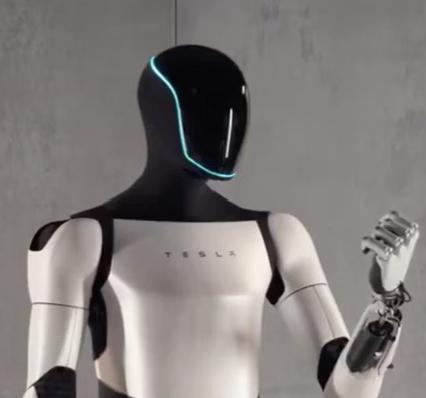
Who knows, after several years of cohabitation, we may even follow orders coming from physical AI!
The designer of the physical AI system must specify the interaction with humans:
- Is the robot social? If so, how should humans feel when they see it? What tasks is it encouraged to perform?
- Should it show empathy? To what degree?
- Is its mission security, reassuring presence, quality control, teaching, or performing manual tasks? Is it an expert or a multitasker?
The case of the Rotunbot ET-G surveillance robot, tested in 2025 by the Wenzhou police in China, is telling: Inspired by Quentin Dupieux’s film Rubber (2010), which features a self-rolling tyre that kills any human in its path, this tyre robot is designed to help the police pursue and arrest individuals. It is equipped with various pursuit, combat and capture features. But above all, by drawing on the imagination of a film, the designers sought to amplify the robot’s deterrent power.

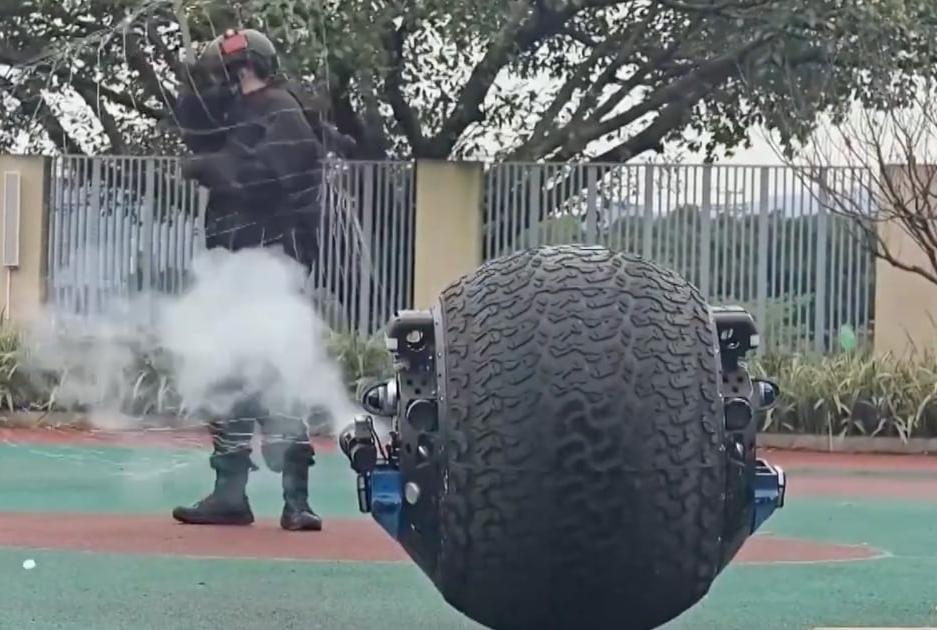
6- For major brands, physical AI will represent a tremendous opportunity: offering their audience an immersive experience
Unlimited possibilities are opening up in terms of brand communication. Take the case of tyre manufacturer Michelin, known worldwide for its century-old Bibendum character. Bibendum’s physical AI will be able to address all its audiences directly, in a personalised and interactive way: with children during the Tour de France cycling race (bottom left), or tyre buyers who need to understand why Michelin tyres justify a higher price (bottom right).

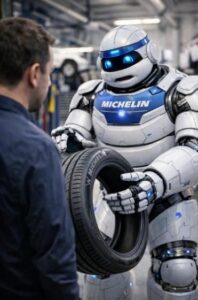
The brand’s physical AI will also enable it to interview customers using natural language, collect their opinions and suggestions, promote the brand’s products, and thus create a memorable experience.
The editorialization of training data is made even easier as these major brands have been carefully characterized in terms of universe, mission, role, personality traits, values, contexts of use, and fields of legitimacy. Moreover, they have accumulated a trove of training data: visuals and advertising films, editorials, promotional arguments, customer service content, user guides etc.
Physical AI will certainly incorporate heroes from video games, comics, films, tales, myths and stories, such as Walt Disney or Harry Potter characters. It will also represent real, historical or contemporary figures: models for major luxury brands, stars and celebrities, high profile politicians and business leaders. In 2025, Albania appointed an AI generated prime minister! This is just the beginning.
7- Success factors in the crucial design phase
The challenge for designers of future physical AI systems is to embed them within a human ecosystem, and to design not only what they do, but also what they are and the place they occupy in our societies.
The need for an ethical framework grows with the intensity of the relationship with the user: AI has often been used to relentlessly grab the attention of viewers, because the business model was based on targeted advertising. Purposeful design choices have led to addiction among users, over activating the brain’s reward circuits and injecting a continuous stream of stimuli.
Avoid the trap of designing physical AI solely for moments when it interacts with the user or the surrounding world. A good practice is to consider the object outside of its period of use – for recharging and storage – as well as its reaction to bad weather, intrusion, or vandalism.
The design stage should look beyond the disciplines of AI and robotics to include creative designers, data scientists, marketers, experts in the target usage context, psychologists, historians, etc.
Geoffroy de Grandmaison – GdeG Consulting
Alexandre Bernelin – Padesign